
Watching your savings tick towards zero
"Hey, I think we're not going to renew our contract with you next month."
It was March, and my one fractional CMO client was on the phone. They were going through some changes and trying to figure out their next steps. One of their co-founders and I disagreed on direction and how to approach the work, which was making things tough. So I said, "Yeah, I think that makes sense. That's probably for the best for both of us."
We'd done some good work together, but I was ready to put my energy into MetaMonster, which I could feel struggling and slipping. I decided it was time to make it work or “die” trying.
Eight months later, I'm taking a step back after our best month ever. Here’s why.
Two years of full-time focus
When I was running my product design agency Krit, I saw the same pattern over and over: it took about two years of full-time focus to really get a SaaS business off the ground.
My co-founder had a baby on the way and a full-time job he couldn't quit. So one of us needed to go full time, and it was going to be me.
I'd saved money from selling Krit, so I had six or seven months of expenses in a rainy day fund and another ten months in a fund I'd set aside for building my next startup.
I decided it was time to test my two years hypothesis, and start putting that money to use.
It's working, just slowly
We've made a lot of progress. Earlier this year MetaMonster had dipped to a handful of customers, and we've grown slowly but steadily since.
If you look at our revenue chart, you can see the dip when I got busy and distracted with client work, the climb once I started focusing full time, and the difference it made when our third co-founder Jade joined in May.
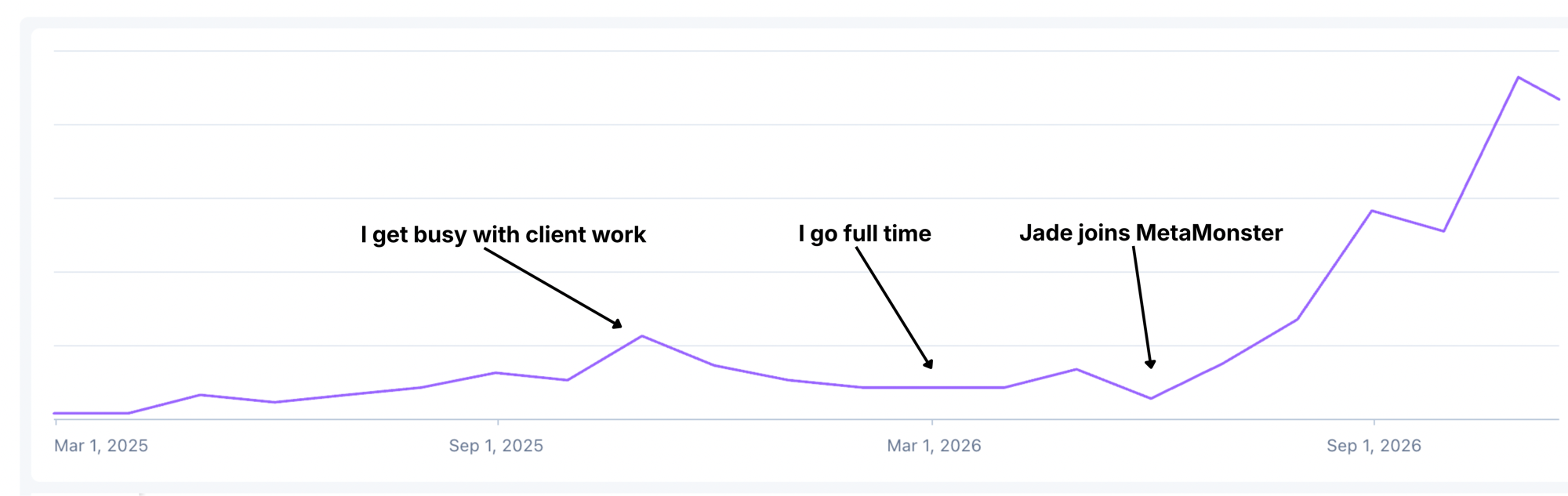
The flip side is that MetaMonster still can't pay my bills, and it probably won't in the next three to six months either. Unless we hit a major inflection point, that's most likely a year or more away.
Note: while the graph may make it look like we’ve hit that inflection point, new customers are still sporadic at best and the overall numbers are still small.
What runway doesn't measure
I still have runway left. I'm down to five or six months, partly because I'm renting an older house that needs some work, I'm furnishing it from scratch, and a chunk of my startup fund is going into that.
But the number in the bank isn't the whole story.
It's the pain and frustration of pouring myself into something for two and a half years and still being so far from it returning an income, and the unknown of not knowing where my next income source is going to come from. Watching your savings tick down toward zero takes an emotional toll that a runway calculation doesn't capture.
Enough of a toll that it has started to cause some resentment toward my co-founders.
They both have successful, full-time jobs outside of MetaMonster and so we have very different timelines and levels of urgency. I feel a lot more pressure to make this work right now, and that creates a lot of tunnel vision that hasn’t been healthy for the business or our relationship.
There's a feeling of inequity too, because I'm sinking more of my money and time into this.
I chose that willingly and they never asked me to. If anything, they've always supported me taking a more long-term approach. But I've been carrying a lot of guilt and pressure and stress, and it’s begun to impact our relationship.
That’s unacceptable, and untenable. My co-founders are two of my closest friends, and for MetaMonster to succeed we need to be able to stick this out for a long time still.
Bootstrapped startups die when the founders lose motivation
I’ve heard Rob Walling, one of my favorite startup thinkers, say multiple times that venture-funded startups die because they run out of money, and bootstrapped startups die because the founder runs out of ideas or motivation. We still have plenty of ideas, but my motivation is truly starting to wane.
MetaMonster needs to survive for the long term, and for that I need to be less stressed, and maintain my relationship with my co-founders.
There’s a cliche that building a startup is like riding an emotional rollercoaster, and it’s a cliche for a reason. One day you have a bad sales call and feel like everything is going horribly, and the next day you get an email from a happy customer and think, oh my God, we're on top of the world, we're going to make this thing work. To weather that up and down, I need a more sustainable path.
So I'm making a different bet: that three people working part time can build MetaMonster into a real, successful, profitable business.
Taking this bet scares me in a different way. So many founders I respect will say that starting a business takes a different level of focus. That the only way to do it is to give it everything you’ve got. I worry that taking a backseat now will torpedo the hard-fought momentum we’ve built since March.
But for now, I need a better way. So this is the bet I’m taking, until MetaMonster is ready to pay someone to be full time. Which leads me to what I’m going to be working on next…
Sell raw materials or do the work
In his recent post about shutting down his startup Changebot, my friend Brian Sierakowski talked about the idea of the software dead zone. SaaS used to be a tool for someone doing work, but in the age of AI being a tool for someone doing work is getting harder and harder to sell. You either need to sell raw materials so people can build their own tools and their own agentic, automated systems, or you need to do the work for people.
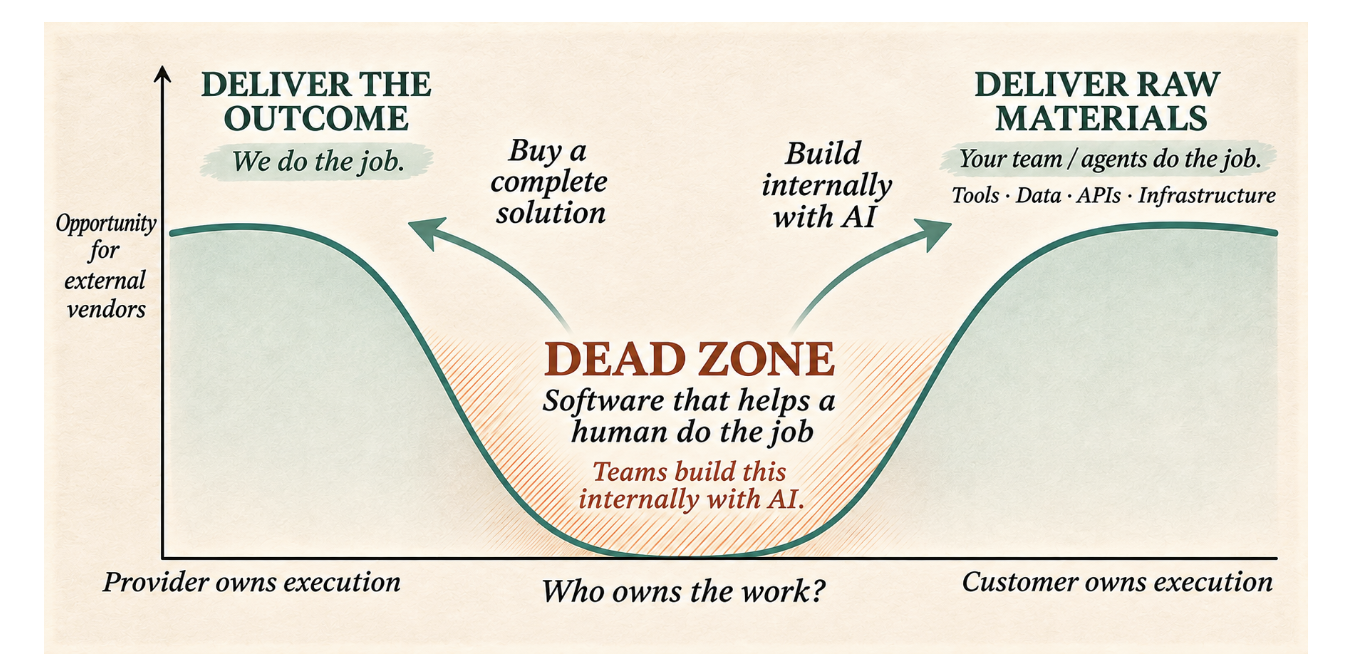
Note: Brian’s illustration of the software dead zone.
MetaMonster is still figuring out which end of that spectrum to occupy, and we're testing both.
- We're building and tuning an automation system for founders and in-house teams, so MetaMonster will do most of the SEO/AEO work for them.
- For agencies we’re making MetaMonster fully accessible through MCP and API so they can build our context library, content analysis, and publishing pipeline into their own content systems.
But we still don’t know which one will work, or if either will work long term.
At the same time, if the software dead zone proves to be true, agencies and service businesses are in the perfect position right now, because they excel at done-for-you.
A lot of people don't have the time or the knowledge to build internal systems. They just want someone to deal with it, own it and be responsible for it.
As much as we can outsource to AI, we can't outsource responsibility. There's still value in knowing someone's owning this, someone's watching it, someone's maintaining it.
So I’m starting an agency.
Back to agencies, on different terms
Building an agency again feels a little funny, because when I sold Krit I swore to myself I would never start another agency again. I was burnt out from 8 years of building Krit, and I was always jealous of the margins of SaaS businesses.
SaaS was the perfect business model, that could enable the lifestyle I always wanted to create for myself and my team. I wanted to give people as much time off as possible, pay people really well and give them the best benefits possible, and agencies made that really tough.
But you can build an agency more efficiently now than ever before. You can build your own internal tools and create true tech-enabled, productized services that hopefully scale more easily than agencies could in the past. I think you can build something that's a hybrid between a software business and an agency, and make it more profitable, more steady and more stable.
So that's what I'm trying to do with Offmage.
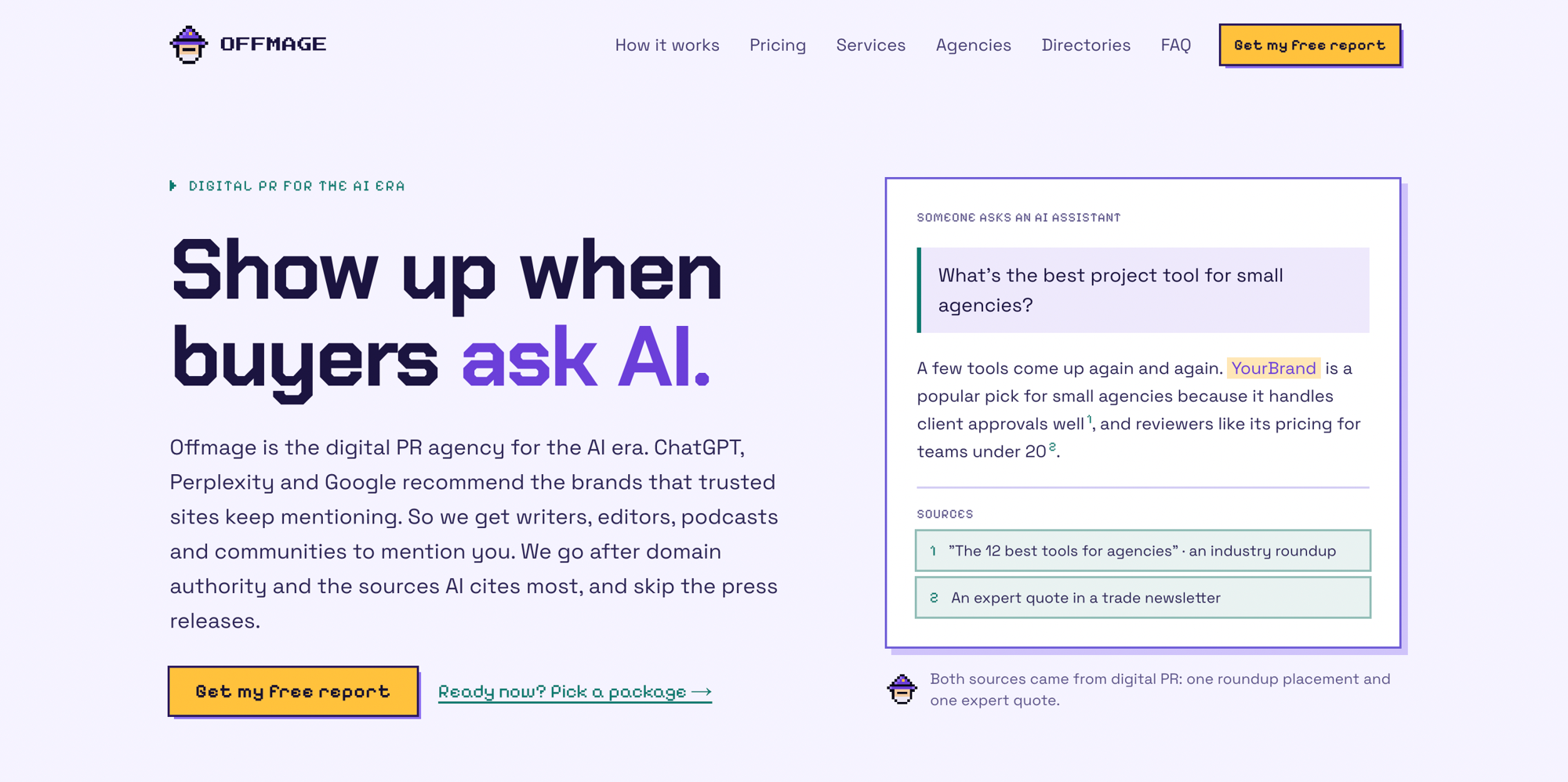
Offmage is an AI-native digital PR firm, focused on helping you earn the backlinks and citations that matter for SEO and AI search.
I’ve always struggled with everything off-page when it comes to SEO. I’ve tried a variety of PR services over the years both for myself and for the companies I worked for. All of them were either too old school, too expensive, or required too much of my time. None of them seemed to understand my business, or think about things from a search-first perspective.
So Offmage is a done-for-you digital PR service, in the model I've always wanted. We're building our own tooling to do the grunt work: scanning for backlink opportunities and directories, drafting pitches and follow-ups, and monitoring to make sure links and citations actually get added. The humans are the strategists and account managers who review the pitches and work with clients directly.
My hope is that Offmage becomes my income source, stops the bleeding on my savings and steadies my life, so I can take the long-term view with MetaMonster.
A year from now
If this works, here's what my portfolio of projects looks like a year from now.
Offmage has a small team, and is my main source of income. I’m able to pay both myself and my team well, and provide them with lots of time off and strong benefits.
It takes up 40 to 60% of my time, but I'm not in the day-to-day execution work anymore. I’m focused on sales, client management, strategy and growth. The systems are in place, and we've got some strong case studies. I can cover my costs, replenish my savings and invest in the future, and I can travel more and put money into my personal projects without feeling stressed.
MetaMonster has a good, strong foundation and much clearer positioning. We're starting to double down on our bets, and it's growing steadily, maybe even very quickly. I'd obviously love to find an inflection point, and if we do, we'll figure out how one of us can focus on it full time again.
Either way, I won't be relying on MetaMonster to pay my bills, and I'm betting that's the best thing for MetaMonster too.
I’ll be writing about everything along the way, so expect to see a return to agency content here on the site as I figure out how to grow an AI-native, productized service in 2027.